

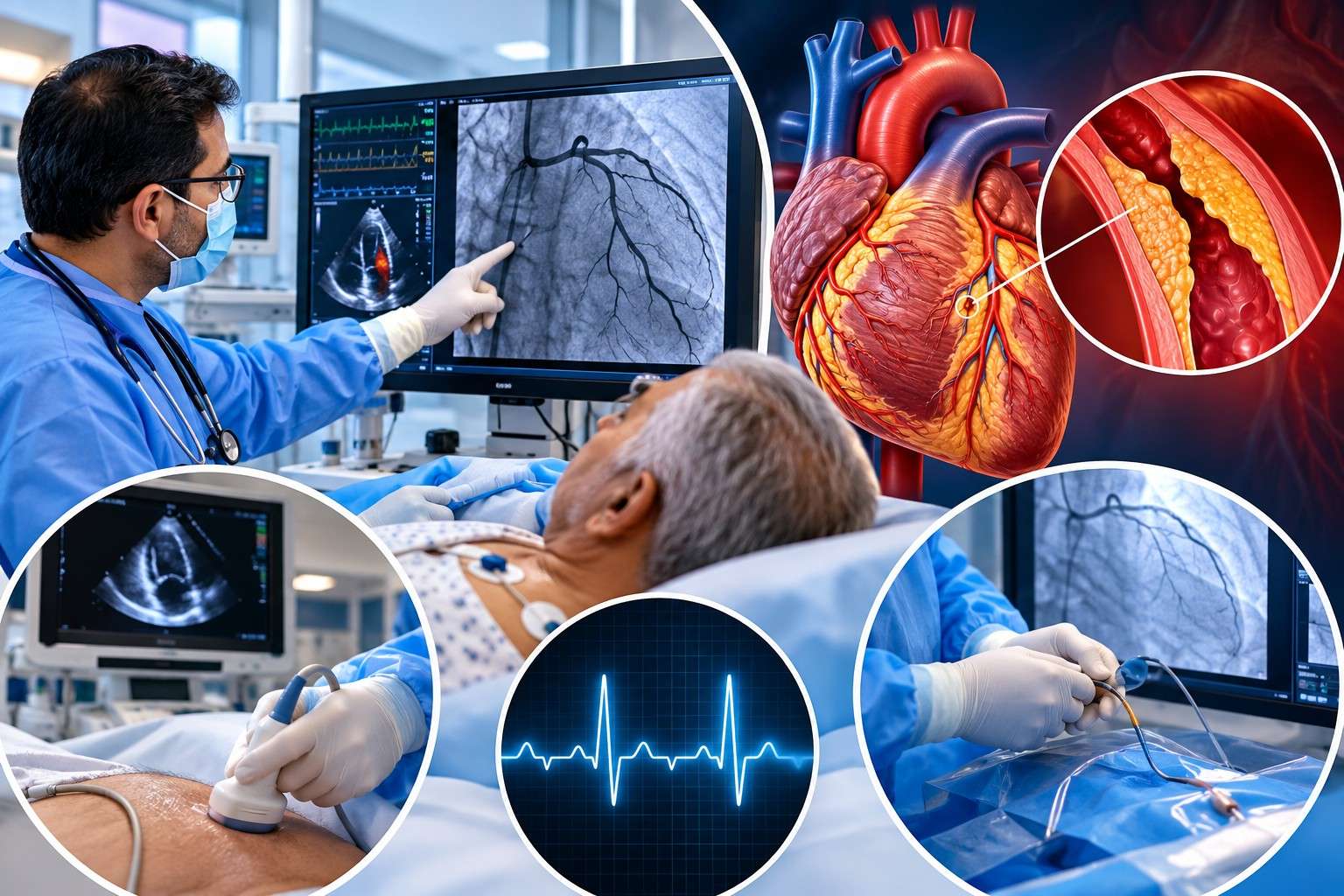
Heart obstructions arise in cases where the coronary arteries responsible for supplying the heart with oxygenated blood are blocked. To varying degrees, patients experience various forms of chest pain, shortness of breath, fatigue, and inability to perform physical activity. Sometimes, obstruction might not show up any symptoms until its late stages.
The Best Interventional Cardiologist in India performs various medical, physical, cardiological, and imaging tests to establish whether there is coronary artery disease present in a patient. The way in which the doctor will conduct the tests varies according to patients’ symptoms, risk factors, medical history, and preliminary test results.
What Goes on in the First Consultation?
This first step typically involves an elaborate consultation with the Best Interventional Cardiologist in India concerning the symptoms and medical background of the patient. Some of the questions raised by the physician could be related to chest pains, breathlessness, dizziness, weakness, palpitations, or altered performance during exercise. In addition, information concerning diabetes, hypertension, hypercholesterolemia, smoking habits, obesity, and heart diseases in the past could also be important.
The physical examination could involve the determination of blood pressure and heart rate, while medical records from the past could help in giving a better understanding of the cardiovascular condition of the patient.
The importance of this consultation is to establish whether there is a need for further investigations in relation to the heart.
Can an ECG Detect a Heart Blockage?
An electrocardiogram, which is more commonly referred to as an ECG or EKG, is a test that measures the electrical activity of the heart. It is one of the most frequently conducted initial heart tests.
An ECG will not diagnose a blockage in one of the coronary arteries. Nevertheless, it can detect specific signs of electrical malfunction or changes that could point to the state of the heart. Under certain conditions, an ECG may suggest that further examination is required.
It is a fast and non-invasive procedure during which electrodes are attached to the skin of the chest and limbs.
How Can an Echocardiogram Assist?
An echocardiogram makes use of sound waves to produce images that show how the heart is working. It helps medical practitioners evaluate various aspects of the heart, including the chambers, valves, pumping action, and heart muscle movements.
Even though an echocardiogram cannot show coronary artery blockage in the manner that coronary angiography does, it can still assist in giving useful information regarding the working of the heart. Any irregularities in heart muscle movement could mean that there is insufficient supply of blood in parts of the heart.
Based on the symptoms of the patient and other results, the echocardiogram can be used alongside other tests for the creation of a thorough evaluation.
What is the Function of Blood Tests?
Blood tests could prove to be useful for cardiac investigation as well. More specifically, when a patient presents with symptoms of an acute coronary event, it is possible to test for cardiac biomarkers in their blood.
When the levels of specific biomarkers are elevated, that suggests some heart muscle damage has occurred. Nonetheless, blood tests alone cannot tell about the exact location of coronary obstruction. They have to be interpreted in combination with other findings.
Additionally, some blood tests are used to assess the risk factors for cardiac problems, including cholesterol and blood sugar.
How does coronary angiography detect blockages?
Coronary angiography is among the major imaging techniques employed for viewing the coronary arteries. In this process, a catheter is inserted into a blood vessel and moved towards the heart.
Contrast is then injected into the coronary arteries. X-rays help in taking images as the contrast passes through the arteries. Places where there is limited blood flow indicate that there could be narrowing or blockage of the arteries.
The results obtained from the coronary angiography may give information about the number of blockages, their location and the extent of the problem. The results may help in deciding the appropriate form of treatment, which may be medication, angioplasty, stents or any other.
Are Stress Tests Useful for Detecting Heart Diseases?
If it is appropriate for a particular patient, a stress test can be conducted in order to assess heart function under increased activity. Under a stress test, the Best Interventional Cardiologist in India can observe the heart rate, rhythm, blood pressure, and other indicators in response to exercise or administration of drugs that put a strain on the heart.
Stress tests are able to detect signs of a decrease in the flow of blood to the heart muscle. In some cases, stress tests can be used together with imaging.
Not all patients who are suspected to have coronary artery disease require a stress test. It depends on various factors such as symptoms, clinical features, risk factors, and previous investigations done.
Conclusion
Heart blockage diagnosis is an elaborate process that includes analyzing the signs and symptoms, the history of the patient, performing the right cardiac tests and, in some cases, undergoing coronary angiography or imaging tests. Tests that a patient will go through differ depending on various factors, and hence the cardiac testing should be patient-specific.
If one is looking for the Best Interventional Cardiologist in India from abroad, Cure Globe Medical Tourism can help in arranging all the medical travel needs. It helps patients organize everything regarding their trip to undergo heart treatment.
